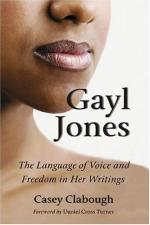
Though not one of the best-known of contemporary black writers, Gayl Jones can claim distinction as the teller of the most intense tales. Her stories are powerful depictions of madness and violence in...
Read more
Gayl Jones, a contemporary African American writer, explores in her novels the effects that racism and sexual abuse have on successive generations of black women. She says of her own writing, "I am in...
Read more

In the following essay, Harris outlines the plot and themes in Jones's narrative poem Song for Anninho.
In Gayl Jones's long poem, Song for Anninho, Almeyda, whose narrative voice we ...
Read more
In the essay below, Ward discusses the importance of the characters’ thoughts and acts of thinking in White Rat, Eva's Man, and Corregidora.
In the American penal system, female priso...
Read more
In the interview below, Jones discusses her writing method, her intent in writing, and the differences between men and women writers.
Gayl Jones was born in 1949 in Lexington, Kentucky where she li...
Read more
In the following excerpt, Birkerts argues that while Jones raises interesting questions about the distinctive form of African-American writers, her theories are flawed and she fails to take into accou...
Read more
In the following essay, Gottfried posits that Jones addresses an unusual topic for an African-American woman author by examining the roles of power in sexual ownership and political empowerment.
Ga...
Read more
In the following review of Liberating Voices and White Rat, Wilentz states that while Jones's academic writing may be flawed, her commitment to first-person narrative has allowed her to discuss...
Read more
In the essay below, Johnson develops the thesis that Jones employs Blues structure and content in Eva's Man as a means of describing problems particular to African-American women.
When I was...
Read more
In the following essay, McKible analyzes the definitions of power and identity in the context of naming in Jones's Corregidora, Toni Morrison’s Beloved, Octavia Butler’s Kindred, ...
Read more
In the following excerpt, Dubey examines Eva's Man in light of the prescribed writing structures of the Black Aesthetics movement, arguing that Jones's focus on gender issues over racial...
Read more
In the essay below, Dubey analyzes Jones's use of a matrilineal structure to achieve meaning in her novels Corregidora and Song of Anninho.
Since the publication of Alice Walker’s In ...
Read more
In the essay below, Basu discusses the political motivations behind critical reaction to Jones's work and argues that Eva's Man differs from other African-American writings.
In the pa...
Read more
In the following essay, Morgenstern discusses the role of trauma and repetitive accounts in Jones's Corregidora and Toni Morrison’s Beloved.
In “Negotiating Between Tenses: Wit...
Read more
In the following essay, Wilcox, a professor at Washington State University, applies Michel Foucault’s theories on discourse to analyze Jones's use of silence in Eva's Man.
In a...
Read more
In the following review of The Healing, Boyd remarks favorably on the novel’s characters and plot but argues that Jones fails to provide enough details.
Like a bright idea, Gayl Jones first ...
Read more
In the following review of The Healing, Grossman states that the book differs from Jones's earlier works but that her humanistic romance is as moving as her previous novels.
The appearance o...
Read more
In the review below, Nelson praises the language, character development, and message of The Healing.
There was a time, not all that long ago, when writers could choose to be private people. People ...
Read more