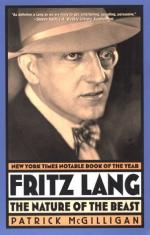
Lang, Fritz (1890-1976)
Widely influential filmmaker Fritz Lang fled Nazi Germany in 1932, eventually settling in Hollywood where he made over 20 films. His crime dramas, including thrillers like The...
Read more
Austrian-born American Fritz Lang (1890-1976) was one of the world's great film directors. He played a major role in shaping two national cinemas: the German during the 1920s and early 1930s (with fil...
Read more

Critical Essay by Bertram Higgins
Anyone who is indifferent or hostile to the Cinema should make a point of seeing Destiny…. [It is a very remarkable German production that is] bound, sooner or...
Read more
Critical Essay by Gavin Lambert
[One can see] that Lang's career in the classic German cinema, embracing as it did most of its tendencies, serves in itself as a kind of allegory. In a variety o...
Read more
Critical Essay by John Russell Taylor
The first thing to strike the casual observer about Fritz Lang's recent films is his apparent interest in returning to his own sources and going over his o...
Read more
Critical Essay by John Gillett
Tigress of Bengal is an incoherent amalgam of portions of [The Tiger of Eschnapur and The Indian Tomb], weighed down by childish American dialogue and out-of-synch dubbi...
Read more
Critical Essay by David L. Overbey
The figure of the femme fatale, appearing as early as Die Spinnen, turns up again and again as a constant motif in [Lang's] work; thus the career girl [as por...
Read more
Critical Essay by Iris Barry
The producer [of The Niebelungs], Fritz Lang, already famous in this country as the begetter of Destiny and Sumurun, was once a painter, which probably explains why, in ut...
Read more
Critical Essay by David Thomson
In Lang's films, interiors are atmospheric geometry before they are a home for anyone. [Late] in Ministry of Fear, [Stephen Neale] and the girl come to an apartm...
Read more
Critical Essay by Robert A. Armour
Lang's films reflect the struggle within his people as they respond to the pushes and shoves from the dual sides of their character. In medieval morality play...
Read more
Critical Essay by Don Willis
The earliest examples we have of Lang's work, The Golden Sea and The Diamond Ship—completed parts one and two of a projected four-part "series"...
Read more
In the following essay, Bellour provides an analysis of Lang's common cinematic techniques used throughout his career.
An amazing fate, Fritz Lang's, and fraught with paradox.
Like Stroh...
Read more
In the following essay, Kaplan asserts that while Lang correctly assessed the decline in male authority in the public and private spheres, he puts forth only one solution: a return to the old-style pa...
Read more