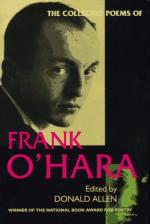
Frank O'Hara was a leading member of the so-called New York School of poets, a group that included John Ashbery, Barbara Guest, Kenneth Koch, and James Schuyler and received its name from its associa...
Read more
Frank O'Hara figured in the Beat scene as one of the major poets (Charles Olson, Robert Creeley, and Robert Duncan would be others) who were close to the leading Beat poets but not actually part of t...
Read more
Frank O'Hara was a dynamic leader of the "New York School" of poets, a group that included John Ashbery, Barbara Guest, Kenneth Koch, and James Schuyler. The Abstract Expressionist painters in New Yor...
Read more

In the following essay, Vendler provides a thematic and stylistic analysis of O'Hara's poetry.
Now that Knopf has given us O'Hara's Collected Poems they had better rapidly ...
Read more
In the following essay, Molesworth considers O'Hara's place within the context of modern poetry.
Frank O'Hara's Collected Poems, as profuse in their inventiveness as they a...
Read more
In the following review, Meyer surveys the strengths and weakness of O'Hara's verse and links his work with the poetry of Guillaume Apollinaire.
Since the last War the United States has ...
Read more
In the following essay, Perloff delineates the defining stylistic features of O'Hara's verse.
—and it was given to me as the soul is given the hands to hold the ribbons of life! a...
Read more
In the following essay, originally published in 1978, Kikel discusses O'Hara as a gay poet.
The stream seems to have spilled itself out, the stream that (after the freak Fire Island beach accid...
Read more
In the following essay, Feldman examines stylistic aspects of O'Hara's poetry.
O'Hara's poetry is innovative, but he disliked theorizing. His attitude toward the craft of p...
Read more
In the following essay, Blasing considers O'Hara's use of language in “Biotherm.”
Reflect a moment on the flesh in which you're mired
(“In the Movies”...
Read more
In the following essay, originally published in 1988, Elledge investigates the influence of the cinema on O'Hara's poetry.
No poetry has been more influenced by the movies than Frank O...
Read more
In the following essay, Bowers emphasizes the importance of New York City in O'Hara's poetry, yet contends that his association with the city has ultimately devalued his work.
Frank O...
Read more
In the following essay, Lowney explores O'Hara's utilization of parody, appropriation, and allusion in his poetry and addresses his treatment of the “issue of cultural memory in p...
Read more
In the following essay, Eberly finds parallels between the poetry of Walt Whitman and Frank O'Hara.
Born almost one hundred years apart, Walt Whitman and Frank O'Hara lived to chronicle ...
Read more
In the following essay, Bredbeck considers the role of homosexual semiotics in O'Hara's poetry, utilizing Roland Barthes's theoretical writings.
Give yourself over to absolute ple...
Read more
In the following essay, Goldstein contends that O'Hara effectively addresses the crisis in the movie picture industry in the late 1950s in his poetry.
Gi; “to the Film Industry in Crisis...
Read more
In the following essay, Stein explores O’Hara’s break from literary tradition and places him in the context of the 1950s.
It may seem surprising to include within a study of “hist...
Read more
In the following essay, Crain utilizes the work of child psychiatrist D. W. Winnicott in order to explicate stylistic aspects of O'Hara's poetry as well as his poetic theory of Personism...
Read more
In the following essay, Epstein asserts that “Choses Passagès” is a compelling poem that encourages further study of O’Hara’s friendship with poet John Ashbery.
Gi; ...
Read more
In the following essay, Sweet investigates the influence of French avant-garde art and the painting of Jackson Pollock on O'Hara's verse and poetic theory.
In his apologetic letter of re...
Read more
Critical Essay by Thomas Byrom
Some poets should be allowed to wear their talents lightly. Frank O'Hara … has been badly overdone by his friends and devotees, with their disfiguring puff...
Read more
Critical Essay by Paul Zweig
1956–57 were good years for literary revolution. That is when Meditations in an Emergency and Howl appeared on opposite coasts, two of the most important first book...
Read more
Critical Essay by Aram Saroyan
O'Hara places himself most succinctly in his most famous essay, "Personism: A Manifesto," perhaps the closest thing to a definitive statement of the...
Read more
Critical Essay by Fred Moramarco
It is in the poetry of New York poets like O'Hara and Ashbery that the painterly esthetic of Abstract Expressionism manifests itself in literary art, though Ols...
Read more
Critical Essay by Marjorie Perloff
[It is] my growing conviction that O'Hara is one of the central poets of the postwar period, and that his influence will continue to grow in the years to come...
Read more