Sir Francis Galton
1822-1911
British gentleman scientist and cousin of Charles Darwin (1809-1882) who studied meteorology and anthropology, but is best known for founding the eugenics movement. Eugeni...
Read more
The Study of Human Heredity and Eugenics During the Nineteenth Century, Focusing on the Work of Francis Galton
Overview
Francis Galton (1822-1910) first coined the term eugenics in 1883. It stems from...
Read more
Francis Galton
1822-1911
English Biologist and Statistician
Francis Galton has been called the last of the gentleman scientists—men who dabbled in
science as a hobby rather than a profession. G...
Read more
Galton, Francis
Francis Galton (1822–1911), the scientist who created and promoted eugenics, the notion that a fitter human race might be created through selective breeding, was born near Birmi...
Read more
The English scientist, biometrician, and explorer Sir Francis Galton (1822-1911) founded the science of eugenics and introduced the theory of the anticyclone in meteorology.Francis Galton was born on ...
Read more
Born on February 16, 1822, in Birmingham, England, Francis Galton was the youngest of nine children of Samuel Tertius, a banker, and Frances Anne Violetta Galton. At the age of 16, Galton enrolled at ...
Read more
Francis Galton was born near Birmingham, England, in 1822. His impressive talents appeared early. At the age of three, he was already reading, and at four, he was studying Latin. His I.Q. at adulthood...
Read more
Sir Francis Galton developed medical genetics, founded eugenics, and introduced biostatistical methods to the study of inheritance.Born into a life of leisure as the son of a wealthy banker in Birming...
Read more
Francis Galton was born near Birmingham, England, in 1822. His impressive talents appeared early. At the age of three, he was already reading, and at four, he was studying Latin. His I.Q. at adulthood...
Read more
Galton was a pioneer in the use of statistical methods as applied to biological problems. He was interested in the heredity of intelligence, and he used many statistical methods to attempt to correlat...
Read more
Francis Galton was born near Birmingham, England, in 1822. His impressive talents appeared early. At the age of three, he was already reading, and at four, he was studying Latin. His I.Q. at adulthood...
Read more
Sir Francis Galton is best known for his scientific work, especially in meteorology and heredity, two fields in which his work is considered foundational. He is probably best remembered as the founder...
Read more



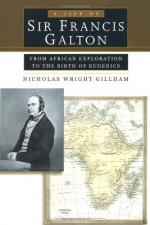
 Sir Francis Galton
 Galton, Francis
 Francis Galton, Sir
 Francis Galton, Sir
 Francis Galton
 Francis Galton
 Francis Galton
 Francis Galton
 Francis Galton
 (Sir) Francis Galton