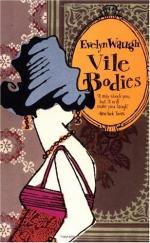
Biography EssayArthur Evelyn St. John Waugh was born on 28 October 1903 in Hampstead, England, and grew up in a comfortable middle-class London suburb, the son of Arthur Waugh, a well-known literary c...
Read more

The English author Evelyn Arthur St. John Waugh (1903-1966) ranks as one of the outstanding satiric novelists of the 20th century. Hilariously savage wit and complete command of the English language w...
Read more
Arthur Evelyn St. John Waugh grew up in a comfortable middle-class London suburb, the son of Arthur Waugh, a well-known literary critic and publisher, and Catherine Charlotte Raban Waugh. He recalled ...
Read more
Literature must have seemed a predestined interest for Arthur Evelyn St. John Waugh, whose father, Arthur Waugh, was an author as well as head of the publishing firm of Chapman and Hall. Born in the L...
Read more
A major figure in twentieth-century British literature, Evelyn Waugh captured in his novels the attitudes, foibles, and virtues of the British upper classes. From the nostalgic romanticism of Brideshe...
Read more
In the following review of Scott-King's Modern Europe, Orwell argues that Waugh's work is conservative in outlook and lacks necessary elements of political satire.
Mr. Evelyn Waugh...
Read more
In the following review of Tactical Exercise, Beattie calls the volume “minor Waugh,” arguing that many of the stories have gimmicky surprise endings. Nevertheless, Beattie concedes the ...
Read more
In the following excerpt, Stopp discusses Scott-King's Modern Europe and Love Among the Ruins, which he finds to be sad but humorous, and lacking in brutality or sentimentalism.
Scott-King...
Read more
In the following excerpt, Carens examines the postwar novellas Scott-King's Modern Europe and Love Among the Ruins, noting their bleak pessimism and defeatist sentiments.
Two grim, short politi...
Read more
In the following introduction to Decline and Fall, Hollis places the novella in the context of Waugh's life and writings.
The younger generation came in his last years to think of Evelyn Waugh ...
Read more
In the following excerpt from his biography of Waugh, Sykes discusses Waugh's short stories as well as Mr. Loveday's Outing and Other Sad Stories, which Sykes believes is “not an ...
Read more
In the following essay, Blayac argues that as a metaphor for changing social conditions “Bella Fleace Gave a Party” ranks among Waugh's best works of short fiction.
In his somewha...
Read more
In the following excerpt, Davis compares and contrasts Waugh's early short fiction, exploring his techniques and influences.
Waugh's undergraduate fiction, except for “Anthony: Wh...
Read more
In the following review of Charles Ryder's School Days and Other Stories, Donaldson states that while the collection is of mixed quality, “Mr. Loveday's Little Outing,” and...
Read more
In the following review of Charles Ryder's Schooldays and Other Stories, Broyard finds the work completely without merit.
With the exception of Put Out More Flags, I think I've liked all...
Read more
In the following essay, Davis argues that a comparison of the original typescript and the final version of Waugh's frame story “Period Piece” reveals that his revisions, extended ...
Read more
In the following essay, Meckier posits that, although “Ryder by Gaslight” is well-written, Waugh was correct not to publish it.
Truly posthumous writings, by the author himself, raise di...
Read more
In the following excerpt, Stannard discusses some of the short stories as they relate to Waugh's development as a writer and his career as a novelist.
The ‘novel’ which had begun ...
Read more
In the following excerpt, Crabbe praises Decline and Fall as hysterically funny and very appealing, while exploring the depth and complexity of Waugh's plot and structure.
Decline and Fall, Wau...
Read more
In the following excerpt, Davis examines an untitled early fragment of a story and “Charles Ryder's Schooldays” in an attempt to discern the autobiographical nature of Waugh...
Read more
In the following excerpt, Garrett explores the nature of the humor in Decline and Fall, praising Waugh's use of language and narrative structure.
In September 1927, staying with his parents at ...
Read more
In the following essay, Beaty analyzes the ironic tone of Decline and Fall.
For Decline and Fall, in manuscript subtitled “The Making of an Englishman,” Waugh invents a complex of shocki...
Read more
Critical Essay by Edmund Wilson
Nothing can taste staler today than some of the stuff that seemed to mean something [at the end of the twenties], that gave us twinges of bitter romance and thrills of ...
Read more
Critical Essay by Stephen Jay Greenblatt
Evelyn Waugh, like Charles Ryder [the narrator of Brideshead Revisited], is an architectural painter who sees, with anger, horror, and a kind of fascination, t...
Read more
Critical Essay by Martin Stannard
Work Suspended is the most enigmatic of Waugh's writings. Its mockery of socialism and philistinism is of course quite in keeping with his rôle as the r...
Read more
Critical Essay by R. J. Macsween
[Waugh's] travelogues are of a very special kind: they do not shout aloud. They present Waugh at his most unobtrusive. He ignores, ordinarily, the famous sites,...
Read more
Critical Essay by Brad Leithauser
The Evelyn Waugh who emerges [in The Letters of Evelyn Waugh] is far more humane and interesting than the man who was presented a few years ago with the publication o...
Read more
Critical Essay by Clive James
Unless the telephone is uninvented, [The Letters of Evelyn Waugh] will probably be the last collection of letters by a great writer to be also a great collection of lette...
Read more
In the following essay, Allen contends that Waugh satirizes the principles of the Futurist movement in art and literature of the 1920s and 1930s in Vile Bodies.
One of Evelyn Waugh's most perce...
Read more
In the following essay, Lynch contends that Waugh's lack of didacticism in his early novels points to his view of the limited ability of fiction to express permanent, meaningful ideas.
Apart fr...
Read more
In the following essay, Nichols discusses Waugh's use of satire in his early novels, focusing on what he considers Waugh's often contradictory ideals of romanticism and realism.
Evelyn W...
Read more
Dooley is a Canadian writer and educator. In the following essay, Dooley examines instances of black humor in Waugh's writing and suggests possible influences to Waugh's comic sensibilit...
Read more
Ulanov is an American writer, educator, and editor. In the following essay, he analyzes the "underlying structure" of the world-view that infused Waugh's novels and gave meaning t...
Read more
In the following essay, Blayac explains the classical meaning of "humor," rooted in the theory of the four humors of the human body, and applies it to Waugh's novels.
Humour, Engl...
Read more
Critical Essay by Steven Marcus
It is almost certain that Evelyn Waugh is the finest entertainer alive. It is certain that both Waugh and the kind of book he writes are supremely distasteful to many o...
Read more
Critical Essay by Michael Howard
Evelyn Waugh was forty-one when the war—his war—ended in 1945. It is an age when most successful professional men have achieved their first senior positi...
Read more
Critical Essay by Paul Fussell
One of the saddest of recent literary sights has been the stacks of unwanted copies of Evelyn Waugh's "Diaries" … visible all over town. Whil...
Read more
Critical Essay by V. S. Pritchett
About Evelyn Waugh as a novelist: It is certain that he was a master in the hardheaded and militant tradition of English social comedy, of which both wit and the fant...
Read more
Critical Essay by James Traub
Evelyn Waugh belongs in the select company of Swift and Twain and a very few others in English literature's Pantheon of Haters. Newspaper editors apparently kept W...
Read more