Hemingway, Ernest
(b. July 21, 1899; d. July 2, 1961) Author.
Ernest Hemingway was one of America's foremost novelists. He began his career as a newspaper reporter and Red Cross volunteer in ...
Read more
Hemingway, Ernest (1899-1961)
At the height of his popularity, Ernest Hemingway was hailed as the greatest writer of American literature, a hero of several wars, a world-class sportsman in the fields ...
Read more
9ernest Hemingway
Excerpt from The Sun Also RisesPublished in 1926
One of the most influential authors of the twentieth century, Hemingway was a leading figure among the famous U.S. expatriates (peopl...
Read more
Few writers have made their mark on American letters and American culture like Ernest Hemingway. Bursting on the American literary scene in 1925 with the publication of the short story collection In O...
Read more
Ernest Miller Hemingway (1898-1961), American Nobel Prize-winning author, was one of the most celebrated and influential literary stylists of the 20th century.Ernest Hemingway was a legend in his own ...
Read more
Ernest Hemingway was twenty-two years old when he arrived in Paris in late December 1921. He had taken part in World War I as a volunteer ambulance driver, and after his experiences in Europe during t...
Read more
Ernest Hemingway is one of the most celebrated and most controversial of American writers. He is seen variously as a sensitive and dedicated artist and as a hedonistic adventurer, as a literary poseur...
Read more
"Any man's life, told truly," Ernest Hemingway wrote in Death in the Afternoon (1932), "is a novel," and he strove to lead a life "better than any picaresque novel you ever read." The mention of hi...
Read more
Biography EssayErnest Hemingway is one of the most celebrated and most controversial of American writers. He is seen variously as a sensitive and dedicated artist and as a hedonistic adventurer, as a ...
Read more
Ernest Hemingway is one of the most recognized and esteemed authors that has ever lived. His life was filled with all kinds of new and diverse experiences, such as his various jobs, time spent at war...
Read more
The Old Man and the Sea presents Santiago, the old man, as he struggles against nature, the sea, and ultimately himself. In this, Ernest Hemingway illustrates the necessity of not only experiencing, ...
Read more
"At 8 o'clock on the morning of July 21st. 1899 Ernest Miller Hemingway came to town wrapped in a light blue comforter. It was a very hot morning. The sun shone brightly and the Robins sang their swee...
Read more
Ernest Hemingway was one of the best known writers of this century. Hemingway overcame a tragic accident which resulted in leaving him partially paralyzed. There is a time when all writers go through ...
Read more
Analysis of Hemingway's Narrative Technique as a Short- Story Writer
For many years, the narrative technique of Hemingway has been under debate. Writers before him had already achieved works that be...
Read more
Hemingway changed the world of literature in the way that Einstein changed the world of physics. He took books into a place where you could use short simple sentence, and still manage to create a com...
Read more
Ernest Hemingway:
The Thrill Seeker
Ernest Hemingway was not just any ordinary American novelist. He had a significant impact on the development of twentieth century writing, and is considered ...
Read more
Existentialism is a philosophy which regards human existence as unexplained and void of meaning. In existentialism there is no god, all life happened by chance and it has no meaning. Many philosophe...
Read more



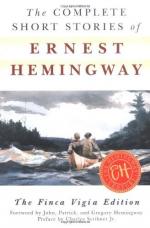
 Hemingway, Ernest
 Hemingway, Ernest (1899-1961)
 Hemingway, Ernest
 Ernest Hemingway
 Ernest Miller Hemingway
 Ernest (Miller) Hemingway

