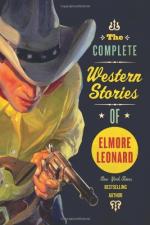
Leonard, Elmore (1925—)
American author Elmore "Dutch" Leonard is often mentioned in the same class as Ross Macdonald and Dashiell Hammett as a writer whose work exceeds the expec...
Read more
Elmore Leonard has been called the greatest living writer of crime fiction. His novels have been compared to the works of the acknowledged masters of the genre, Dashiell Hammett and Raymond Chandler. ...
Read more

Elmore Leonard has been called the greatest living writer of crime fiction. His novels have been compared to the works of the acknowledged masters of the genre, Dashiell Hammett and Raymond Chandler. ...
Read more
Dubbed "The Dickens of Detroit" by Time magazine in 1984, Elmore Leonard has written more than thirty novels, as well as many short stories and screenplays. He began his writing career in the early 1...
Read more
Many critics consider Elmore Leonard to be the best living writer of crime fiction in the United States. Since the mid 1980s he has enjoyed enormous commercial success, and his style has influenced a ...
Read more
Critical Essay by Newgate Callendar
When Elmore Leonard's "Fifty-Two Pickup" appeared in 1974, it had some critics talking in terms of Raymond Chandler and Ross Macdonald. "...
Read more
Critical Essay by Alan Cheuse
I was an Elmore Leonard virgin, perhaps the last one on my block. Then I picked up a copy of his new novel, "LaBrava," and gave myself over to several hours...
Read more
Critical Essay by The Times Literary Supplement
In Elmore Leonard's The Hunted … Ed Rosen, head of a million-dollar mortgage company, is blackmailed by the Justice Department into testif...
Read more
Critical Essay by Connie Fletcher
Leonard's style [in City Primeval] is clear, crisp, and mean. He writes about a tough-guy cop, Raymond Cruz, who lights out after crooks and con artists in one...
Read more
Critical Essay by Robin Winks
Elmore Leonard has written his toughest book in City Primeval: High Noon in Detroit…. It's too bad Leonard felt he needed a subtitle, for the theme is obvio...
Read more
Critical Essay by Ken Tucker
Elmore Leonard strikes me as being the finest thriller writer alive primarily because he does his best to efface style, and has done this so successfully that few readers ...
Read more
Critical Essay by Jonathan Yardley
Leonard's bandwagon had left the station by the time I heard its music, and I've had to do some running to catch up. But better late than never: Leonar...
Read more
Critical Essay by George Stade
[Elmore Leonard] is never more entertaining than when one of his villains is stealing a scene. They are inspired hams, these bad actors, so empty inside that they only b...
Read more
Critical Essay by Raymond Obstfeld
I read an article about [Elmore Leonard] in Writer's Digest a few months ago and went out and bought his City Primeval: High Noon in Detroit…. It...
Read more
Critical Essay by Neal Johnston
The tone of Elmore Leonard's latest mystery ["LaBrava"] is dry and mordant, the action well paced and the voices of the riffraff convincing. I do n...
Read more
In the following review, Morley offers a mixed assessment of Glitz.
You've heard about Elmore Leonard—probably sometime in the last ten days. After a long career of writing pulp Westerns...
Read more
In the following review, Gifford applauds Maximum Bob, and calls Leonard "the greatest living writer of crime fiction."
Elmore (Dutch) Leonard confirms with this, [Maximum Bob,] his 29th...
Read more
In the following essay, Hynes surveys Leonard's career, noting various qualities unique to the author's works.
Elmore Leonard is perhaps as popular as a writer can hope to be. After twen...
Read more
In the following review, Carpenter offers a mixed assessment of Pronto.
Somewhere along the line, it became fashionable to discuss Elmore Leonard in terms formerly reserved for the likes of Flaubert, ...
Read more
The following is Lochte's laudatory review of Pronto.
Elmore Leonard begins his 31st novel [Pronto] with a Miami bookmaker, Harry Arno, about to tell his girlfriend Joyce his biggest secret. Bu...
Read more
In the following favorable review of Riding the Rap, Amis applauds Leonard's characteristic style of narrative and dialogue.
Let us attempt to narrow it down. Elmore Leonard is a literary geniu...
Read more
The following is Worth's positive review of Riding the Rap.
Elmore Leonard has been writing great crime fiction for years with the same cozy formulas, the same cast of South Florida rednecks an...
Read more
In the following excerpt, Kaplan provides a mixed review of Glitz, and compares and contrasts Leonard's novels with works by author Ross Thomas, whose novel is also reviewed.
After eighteen nov...
Read more
In the following essay, Prial surveys Leonard's life and career, and includes commentary by the author on his works and personal experiences.
Birmingham, Mich.
There's a tendency in this...
Read more
In the following essay, Wilkinson presents Leonard's researcher, Greg Sutter, and traces Sutter's various experiences while gathering background material for Leonard's works.
Elmo...
Read more
In the following mixed review of Bandits, D'Evelyn asserts that the novel does not live up to Leonard's abilities as a "master craftsman" of crime novels.
Elmore Leonard is...
Read more
In the following essay, Most examines Leonard's use of language and conventions of narrative and plot to illuminate the moral views of his readers.
Towards the beginning of Elmore Leonard...
Read more
In the following excerpt, Edwards provides a largely positive assessment of Bandits.
Even those who don't care for crime fiction may like what Elmore Leonard makes of it, especially his way of ...
Read more
The following is McFadden's commendatory review of Freaky Deaky.
How dearly Elmore Leonard loves a scam, a con, a slippery scheme. How fond he is of the schemer, especially the schemer who thin...
Read more
In the following essay, Sandels surveys Leonard's crime novels and reveals how the author departs from and provides commentary on traditional crime story formulas; Sandels also delineates stand...
Read more
In the following essay, Baldwin illustrates Leonard's use of symbols and unique approach to conventions of crime fiction and societal norms in Glitz.
In the beginning of Glitz, one of Elmore Le...
Read more