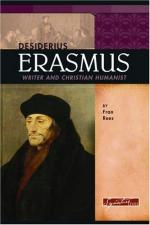
Erasmus, Desiderius
ERASMUS, DESIDERIUS (1469?–1536), Dutch scholar, is called the "prince of humanists." Neither the date nor the place of Erasmus's birth is known with ce...
Read more
Erasmus, Desiderius(1466?–1536)
Desiderius Erasmus, the great Renaissance humanist and scholar, was born at either Rotterdam or Gouda in Holland, the illegitimate son of a priest. As a child he...
Read more
The Dutch scholar Desiderius Erasmus (1466-1536) was the dominant figure of the early-16th-century humanist movement. The intellectual arbiter during the last years of Christian unity, he remains one ...
Read more
In July 1514 Desiderius Erasmus of Rotterdam left England for Basel, Switzerland, and the Froben Press to publish the annotated New Testament and the critical edition of the works of Saint Jerome on w...
Read more
In the following essay, Kahn relates the dispute between Luther and Erasmus on free will in order to highlight the paradoxes in Erasmus's positions on folly and prudence.
Vide, huc perpulit Dia...
Read more
In this essay, Jardine begins with a study of Erasmus's letters as an example of a technical method of expressing and producing feeling. Erasmus's epistolary methods then provide a conte...
Read more
In this essay, Eden shows how Erasmus takes the adage genre as a literary type and makes it a symbol of his philosophy of friendship and community. Eden focuses on Erasmus's adaptations of Pyth...
Read more
In the following essay, Weintraub looks at Erasmus's efforts to reconcile Christian with pre-Christian thought by focusing on his writings on Socrates, including his famous request, “O S...
Read more
In this essay, Rummel classifies the realms of Erasmus's influence in terms of philology, theology, pedagogy, and civility (a blend of the philosopher's commitments to community, toleran...
Read more
In the following essay, O'Malley suggests that it was as a grammarian that Erasmus chiefly defined his humanism, meaning that Erasmus tended to place greater value on texts and teaching rather ...
Read more
In this lecture read at a 1988 conference, Carrington links Erasmus's work on metaphor and ideal language to his theology. She contends that, for Erasmus, metaphor is both the sign of a fallen ...
Read more
In this lecture, originally read at a 1991 conference, Heath discusses Erasmus's controversial proposals for reforming marriage laws and the unorthodox thought behind them. He observes Erasmus&...
Read more
In the following essay, Stevens focuses on Erasmus's letters to his friend Servatius in order to highlight the sexual rhetoric that has more often been interpreted as a nonsexual literary conve...
Read more
In this lecture read at a 1996 colloquium, McConica discusses the early influence of Erasmus on English humanism, particularly in the schools. McConica also notes the importance of the church and stat...
Read more
In the essay below, Tracy considers Erasmus's reform doctrine in the context of political and religious developments of his age. In his reform writings, Tracy claims, Erasmus struggles with the...
Read more
Desiderius Erasmus was born in Holland Germany in 1466. His parents died of the plague when he was only 13. His guardians pressured him into joining a monastery soon after that. He went on to refer t...
Read more
Praise of Folly: A Current Perspective
According to Merriam-Webster's online dictionary, satire is "a literary work holding up human vices and follies to ridicule or scorn." When examining satire o...
Read more