Mather, Cotton
March 19, 1663
Boston, Massachusetts
February 13, 1728
Boston, Massachusetts
Clergyman and scientist
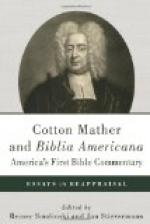
Portrait: Cotton Mather. Reproduced by permission of The Library of Congress.
...
Read more
From the Wonders of the Invisible World (1693) by Cotton Mather
From The Wonders of the Invisible World (1693)
Reprinted in American Literature: A Prentice
Hall Anthology, Volume 1 in 1991
Cotton Math...
Read more
Mather, Cotton
Born: 1663 Boston, Massachusetts
Died: 1728 Boston, Massachusetts
Clergyman, scientist, and writer
Puritan minister Cotton Mather was instrumental in escalating the witch-hunts in New E...
Read more
Mather, Cotton(1663–1728)
Cotton Mather, scholar, clergyman, and author, was the oldest son of Increase Mather, one of the leading figures in the Puritan theocracy in Massachusetts. The younger...
Read more
Biography EssayCotton Mather was born in Boston on 12 February 1663, the eldest child of Increase Mather and Maria Cotton Mather, who was the daughter of John Cotton, an elder statesman of the first g...
Read more
Cotton Mather (1663-1728), Puritan clergyman, historian, and pioneering student of science, was an indefatigable man of letters. Of the third generation of a New England founding family, he is popular...
Read more
Cotton Mather was born in Boston on 12 February 1663, the eldest child of Increase Mather and Maria Cotton Mather, who was the daughter of John Cotton, an elder statesman of the first generation of se...
Read more
Cotton Mather's life was as genetically and environmentally determined as it was for him theologically predestined. The first child of Increase and Maria Cotton Mather, he was born in Boston on 12 Feb...
Read more
The Mather library developed through several generations. Richard Mather began the family book collection, part of which descended to Increase, who made it one of seventeenth-century New England's mos...
Read more
Here, Mather defends the actions taken against those conspiring in the "Plot of the Devil against New England." His text was written in 1693.
'Tis, as I remember, the Learned S...
Read more
In the following excerpt, Gay examines Mather's Magnalia Christi Amricana and argues that it has played a significant role in shaping modern views on Puritan New England.
I
The Founding Fath...
Read more
In the essay below, Duffy reviews Mather's treatment by historians and argues that modern scholars should reconsider the unattractive stereotype that has prevailed.
One may rummage around am...
Read more
In the following essay, Werking discusses Mather's role in a Boston witchcraft case of 1688 and explores the role Mather sought to play in the "Puritan mission in late seventeenth-centur...
Read more
In the excerpt below, Bercovitch discusses Mather's ideas on piety and science as expressed in Bonifacius and The Christian Philosopher.
… Throw a stone into the stream, and the circ...
Read more
In the following essay, Vartanian argues that Mather was able to rectify his ideas on piety and the relationship between God and reason with the teachings of the Enlightenment, including the concept o...
Read more
In the following excerpt, Robinson compares the actions of Increase Mather to those of his son Cotton Mather during the witch trials.
… The year 1692 had opened as a particularly troubling o...
Read more
In the following excerpt, written in 1697, Calef attacks Mather's views on witchcraft.
… Mr. C. M. having been very forward to write Books of Witchcraft, has not been so forward eithe...
Read more
In the following excerpt, Wendell provides a detailed account of Mather's role in the witchcraft trials and surveys the author's writings on witchcraft.
What happened in the next two ...
Read more
In the essay below, Holmes surveys Mather's works and contends that his writings on and role in the witchcraft trials hold a relatively minor place in his career.
Cotton Mather's entr...
Read more
In the following excerpt, Parrington attempts an examination of Mather's psychology and argues that the Puritan theocracy, whose virtues and glories Mather celebrated, was already crumbling whe...
Read more
In the excerpt below, Starkey explores Mather's role in the Salem witch trials.
1.
What had actually been accomplished on the spiritual plane by the wholesale jail delivery of 1693 was a poi...
Read more
In the essay below, Manierre focuses on the Magnalia in his analysis of Mather's writing style and suggests some of the consequences of "appropriating to the written language techniques ...
Read more
In the essay below, Bercovitch describes Mather's Magnalia Christi Americana as a metaphoric account of life in Puritan New England and compares the work to those of Vergil and John Milton.
...
Read more
In the essay below, Levin examines the themes of Mather's Bonifacius, also known as Essays to Do Good, and argues that the book is historically relevant to an understanding of American philosop...
Read more
Mather uses a very objective tone throughout the Trial of Martha Carrier. He begins with introducing the case. He tone is casual, and restricted to the basics. It gives the reader a general overvie...
Read more

Let’s give a warm New York welcome to the 10th anniversary edition of Phillip Lopate’s essential Writing New York: A Literary Anthology (Library of America, $19.95), now in paperback ...
Read more