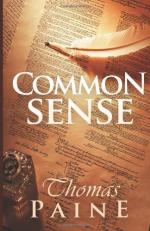
Thomas Paine (1737-1809) was an English-born journalist and Revolutionary propagandist. His writings convinced many American colonists of the need for independence. Thomas Paine came to America in 1774, an unknown and insignificant Englishman. Yet two ye...
Born in Thetford, England, Thomas Paine began life as a corsetmaker, his father's trade. He showed an interest in philosophy and science as a young man, and this interest led him to become an influential thinker during the American and French Revolutions...
"I speak an open and disinterested language, dictated by no passion but that of humanity. . . . Independence is my happiness, and I view things as they are, without regard to place or person; my country is the world, and my religion is to do good." With...
Common Sense - Thomas Paine - 1776 Introduction Thomas Paine's major political essays Common Sense and Rights of Man bookend the two most significant political upheavals of the late eighteenth century. The publication of Common Sense in January...
Relations, Internal and External Common sense would seem to hold that if some properties of a thing were taken away from it, it would no longer be the same thing. Further, it seems to hold that this is not the case for all properties of the thing. This...
Paradigm-Case Argument "Paradigm-case argument" is a form of argument against philosophical skepticism found in contemporary analytic philosophy. It counters doubt about whether any of some class of things exists by attempting to point...
Common Sense Several things can be learned about common sense from Dr. Johnson's attempt to refute George Berkeley by kicking the stone. Its philosophical incompetence is not one of them. Dr. Johnson of course misunderstood Berkeley, and his...
Paine donated the copyright for Common Sense to the states, and as one biographer noted, Paine made nothing from the estimated 150,000 to 600,000 copies that were eventually printed (various sources disagree on the number of printed copies in Paine's...
The article (BDN, Dec. 28) about the rezoning of several parcels of land from their previous designations to "Resource Protection" also contained a statement by the city engineer that this action by the city results in "no change" in the status of those land...
summary from source:
Filipinas
Common Sense 03/31/2006: 1,072 words, approx. 4 pages
By this time, most of you must have already heard or read about Alexander Ledesma Lacson's "Twelve (12) Little Things Every Filipino Can Do To Help Our Country," which has obviously touched a nerve in every concerned Filipino's heart, judging from how widely circulated...
Down through the centuries and all over the world, the battle for religious freedom has been a bitter one. The United States has been no exception. Although most of those who founded this country came here seeking religious freedom, it has been a source of...
BEIJING, Dec 21 (Reuters) - Chinese consumers need to take more personal responsibility in protecting themselves from tainted food by reading labels and not buying obviously shoddy or expired products, an official said on Friday. But people should also not be scared to report...
Summarizes and reviews the pamphlet "Common Sense," by Thomas Paine. Describes each section of the text, the origin of government, the monarchy, divine right and hereditary succession, the present life and affairs in America, and the present and future abilities of America.
Describes the importance of Thomas Paine's book "Common Sense" to the American independence movement. Explores the text and details how the book served as a catalyst for the American Revolution.
Get the complete Common Sense Study Pack, which includes everything on this page. Approximately 363 pages (at 300 words per page) in 24 products. (Download a sample literature guide)