Cold War Mobilization
Between 1946 and 1991, America's rivalry with the Soviet Union spurred the longest continuous wartime mobilization—or state of military readiness—in U.S. his...
Read more
Cold War Novels and Movies
Beyond their value as artistic expression or entertainment, novels and movies are cultural records that reflect a society's views and values. During the Cold War (194...
Read more
Multiculturalism and the Cold War
America's role in the Cold War led the nation to pursue policies that eventually resulted in the rise of multiculturalism. This trend has had an increasing imp...
Read more
Popular Culture and Cold War
In the years following the Second World War, American popular culture mirrored the anxieties that developed between the United States and the USSR. Although allies in the ...
Read more
Rosenberg, Hiss, Oppenheimer Cases
The Cold War (1946–1991) had profound effects on American society and culture. Fresh from victory in 1945, Americans quickly disarmed and expected to focus th...
Read more
Russia-Nato Relations in the Post-Cold War World: Rethinking the Future of Collective Security
The Conflict
Ten west European countries joined with the United States and Canada to form NATO in 1949 as...
Read more
Cold War
As the mid-twentieth century unfolded, the desire to escape Earth's atmosphere to explore space beyond reached a new height. This desire was initially stimulated by the lure of adventu...
Read more
Cold War
Struggle between the Western democracies and the Eastern Communist nations was probably inevitable from the first shot fired in the Russian Revolution of 1917. Guided by one of the essential ...
Read more
The end of the cold war signified a new era of history that has changed the entire world. The face of Europe and Asia has changed dramatically. Vast changes have been felt socially, politically, and...
Read more
Potsdam Conference
July 17 to August 2, 1945
There were several issues agreed upon in the Potsdam Conference, held near Berlin. The main purpose was to implement decisions reached previously in the ...
Read more
I'd like to write a paper on the topics for this week, and mainly about the "Cold War", which outlines the happenings of the First year of the Cold War.
The beginning of the Cold War is looked upon ...
Read more
After WWII Russia and the US became embroiled in a bitter arms race that was to last for decades. The primary point of conflict revolved around political ideology - Russia was communist and the US was...
Read more
Argumentative/Persuasive Essay:
(Brinkmanship--most important during the Cold War)
Trailing events of World War II, uneasy tension grew between two superpowers, the United States and the Soviet ...
Read more
The lead into the Cold War was one of the biggest controversies that America has faced in the last century. All the events leading to, and the war itself were caused because of two things. The Unite...
Read more
Many historians argue that the Cold War began in the 1940's around the time World War II ended. However, there is an abundance of evidence that suggests otherwise. While analyzing the events that o...
Read more
1. How did the Cold War affect your family"
"It affected my family because we were a military family. We were stationed in Germany twice. It is very tough for a military family to move around all the...
Read more
The United states and Soviet union are both to blame for the cold war. Both countries showed no trust for the other . The two countries would deliberately flex there military muscle...
Read more
Everyday in the news one can read about the growing tension between North Korea and the rest of the world. The country is led by a lunatic who wields knowledge of nuclear weapons and no one knows how...
Read more
Dwight `Ike' Eisenhower became the 34th president of the US in 1952. Eisenhower arrived with a `New Look' on how the US were to deal with the international threat of communism. Eisenhower's `New Look'...
Read more
The Cold War refers to a period of prolonged tension and rivalry between two differing political and economic systems, in particular, the United States of America (USA) and the Soviet Union. This peri...
Read more
The Cold War could not have been avoided. The arrival of the Cold War after World War II had always been imminent. There were already disagreements between the West and the Soviet Union at the Yalta C...
Read more
YEREVAN STATE LINGUSITIC UNIVERSITY AFTER BRUSOV
"DROP SHOT: The Star-Spangled Side of Cold War"
By Narek Markarian
Supervisor: E. Danielyan
Area Studies Chair
IV year group # 2
Yerevan 2004...
Read more
USSR indeed has to take some responsibility in causing the cold war. However, there are many other contributing factors to the cause of cold war.
It is true that USSR's foreign policies had led to h...
Read more
The basis of the Cold War was mutual suspicion and mistrust. This essay will discuss the origins of the cold war regarding suspicion and mistrust until the year 1949.
The main origin of the cold war ...
Read more



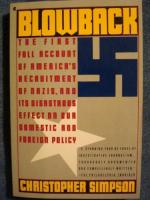
 Cold War Mobilization
 Russia-Nato Relations in the Post-Cold War World: Rethinking the Future of Collective Security
 Cold War
 Cold War
