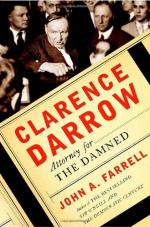
Darrow, Clarence (1857-1938)
Sometimes reviled for his defense of unpopular people and causes, Clarence Darrow was the most widely known attorney in the United States at the time of his death in 1938....
Read more
5clarence Darrow
Closing Argument in the Leopold and Loeb TrialPublished in 1924
In the late spring of 1924 the nation was shocked by the news of a kidnapping and murder in Chicago, Illinois. Nathan L...
Read more
Clarence Darrow
Born April 18, 1857 (Kinsman, Ohio)Died March 13, 1938 (Chicago, Illinois)
Lawyer
Clarence Darrow was one of the most famous lawyers in U.S. history. Always a strong defender of the un...
Read more
As an American labor lawyer and as a criminal lawyer, Clarence Seward Darrow (1857-1938) helped sharpen debate about the path of American industrialism and about the treatment of individuals in confli...
Read more
Clarence Seward Darrow is one of the most famous attorneys in U.S. history. A complex man, Darrow defended many labor union and political radicals between 1894 and 1914, yet also made enormous fees re...
Read more
Clarence Darrow is best known as the attorney who defended John Thomas Scopes, the schoolteacher brought to trial in 1925 for teaching the theory of evolution in his classroom in Hillsboro, Tennessee....
Read more

In the following review of Farmington, the anonymous critic calls the book "insidiously iconoclastic," noting Darrow's use of point of view and his stark honesty.
[Farmington] is ...
Read more
In the following essay, Jezioro discusses the connection of Darrow and H. L. Mencken during the Scopes trial
During the sensational 1925 Scopes "Monkey Trial," H. L. Mencken and Clarence...
Read more
In the following review, Shafer offers high praise for Farmington.
Since Mr. Howells's delightful idyll of boyhood, A Boy's Town, there has perhaps been no worthier companion volume than...
Read more
In the following review, Wood calls Crime: Its Cause and Treatment a "remarkable book. "
Mr. Darrow could probably write a book on any subject, provided that he were given a little spare...
Read more
In the following review, Smith lauds the compassion and individuality evident in Darrow's The Story of My Life.
It might be expected that the life of Clarence Darrow would furnish materials of ...
Read more
In the following essay, Hynd details Darrow's defense of "hopeless" cases.
The old Criminal Courts Building in Chicago was the habitat of the greatest aggregation of hard-drinking...
Read more
In the following essay, Ginger provides an overview of Darrow's life and works.
The career of Clarence Darrow sprawls unpredictably through eight decades of American life. He appeared as defens...
Read more
In the following essay, Rahskopf discusses Darrow's speeches and public addresses.
Students of public address are interested in "the American gadfly," as T. V. Smith dubbed Claren...
Read more
In the following essay, Shuman examines naturalistic elements in An Eye for an Eye, in particular as they highlight Darrow's concern for individualism and revolt.
The most renowned criminal law...
Read more
In the following essay, Lessi analyzes the styles of argument used by Darrow and his opponent William Jennings Bryan in the famous Scopes trial
The concept of the speech set offers the critic a system...
Read more