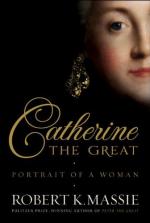
The Russian empress Catherine II (1729-1796), known as Catherine the Great, reigned from 1762 to 1796. She expanded the Russian Empire, improved administration, and vigorously pursued the policy of We...
Read more
It is difficult to define Catherine the Great's place in literature because a long and controversial career made her into a "world-historical" figure who still seems larger than life. In ruling the im...
Read more
In the excerpts below, Waliszewski discusses Catherine's personal and intellectual relationship with the philosophers of the European Enlightenment, particularly Voltaire, but also Diderot, Rou...
Read more
In this essay, first published in Russian in 1947, Gukovskii focuses on Catherine's literary works, particularly her dramas. Gukovskii stresses Catherine's conservatism and didacticism, ...
Read more
In the following excerpt, Haslip focuses on Catherine's relationship with Voltaire, noting that Catherine's correspondence with him and other French philosophers demonstrates the challen...
Read more
In the excerpt below, Cronin provides an overview of Catherine's literary career, relating her works to events in both her private and public life, and tracing her influence on other authors.
T...
Read more
In this excerpt from his biography of Catherine the Great, generally considered the scholarly standard, Alexander provides the historical and political contexts for the production and reception of Cat...
Read more
In this essay, Jones considers the influence of Montesquieu's L'Esprit des lois on Catherine's instructions to the legislature, the Nakaz. Jones notes Catherine's direct ap...
Read more
In this essay, Levitt examines Catherine's Antidote, her response to Chappe d'Auteroche's attack on Russian culture in his Voyage en Sibérie. Levitt argues that although th...
Read more
In this essay, McKenna cites Catherine's facility with employing Russian proverbs as an aspect of her light satirical style in her Spectator-influenced journal Vsiakaia vsiachina.
One of the ma...
Read more
In the essay below, O'Malley demonstrates how Catherine appropriated English comedy to create plays that advanced the cause of Russian nationalism. Focusing on This 'tis to Have Linen an...
Read more
Critical Essay by Aileen Kelly
In the energy with which she pursued the two imperatives of modernization and absolute power, Catherine was by far the most distinguished [successor to Peter the Great o...
Read more
Critical Essay by Nicholas N. Riasanovsky
Henri Troyat's biography of Catherine the Great is an immensely readable book…. (p. 7)
I happened to be reading one of Balzac's novels wh...
Read more
Catherine II, the Great Enlightened Absolutist
Through out the 18th century, Europe experienced a very important movement, which is known as the Enlightenment. Inspired from the Scientific Revoluti...
Read more
In a time where ideas and thoughts spread rapidly, the high and middle class people, began to question its world and the ways of thinking. They had always been followers but the leaders of a new age...
Read more
Catherine the Great was born into the royal German house of Anhalt-Zerbst. She was selected by the Russian Empress Elisabeth to be the wife of the Russian prince Grand Duke Peter at ...
Read more
The real figure and story of Catherine the Great and Peter the Third has been overlaid by gilt and varnish much like the church mural paintings of old. Some of the true story would be uncovered, while...
Read more