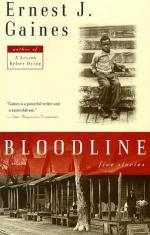
Biography EssayErnest J. Gaines is one of the best known of contemporary black writers. He received popular and critical recognition for the publication and subsequent television production of The Aut...
Read more
"When we moved to California I was lonely, so I went to the library and began to read a lot of fiction," Ernest J. Gaines told Paul Desruisseaux in the New York Times Book Review. It was the late 1940...
Read more
Ernest J. Gaines novelist and short story writer, was born to Manuel and Adrienne J. (Colar) Gaines on 15 January 1933 in the bayou country near Oscar, Louisiana, which lies about twenty-five miles n...
Read more
Ernest J. Gaines is one of the best-known of contemporary black writers. He received popular and critical recognition for the publication and subsequent television production of The Autobiography of...
Read more
[This entry was updated by Keith E. Byerman (Indiana State University) from his entry in DLB 152: American Novelists Since World War II, Fourth Series.]Ernest J. Gaines has since the publication of Th...
Read more

Critical Review by Granville Hicks
Hicks, Granville. “Sounds of Soul.” Saturday Review (17 August 1968): 19-20.
In the following review of Bloodline, Hicks praises the author's ch...
Read more
In the following excerpt from an interview originally published in New Orleans Review in 1973, Gaines discusses the major theme and characters in the stories in Bloodline, the literary influences that...
Read more
In the following essay, McDonald explores the theme of manhood in Bloodline and compares the collection to works by William Faulkner and John Steinbeck's The Grapes of Wrath.
Born on a Louisian...
Read more
In the following essay, Shelton elucidates Gaines's complex portrayal masculinity in Bloodline.
With the recent highly regarded television version of the novel, The Autobiography of Miss Jane P...
Read more
In the following essay, Burke views the five stories in Bloodline as “the record of changing race relations in America.”
One of the finest collections of short stories published in the p...
Read more
In the following essay, Puschmann-Nalenz provides a thematic and stylistic analysis of “A Long Day in November” and views the story as a precursor to Gaines's popular novel The Au...
Read more
In the following essay, Duncan examines the way Gaines depicts the process of maturation and aging in Bloodline, comparing events in the stories to the eight life-cycle stages theorized by psychoanaly...
Read more
In the following interview, which was originally conducted in 1979, Gaines comments on the origins of “The Sky Is Gray,” discusses his metaphorical use of colors, and identifies the lite...
Read more
In the following essay, Callahan contends that in Bloodline “voice becomes a transforming agent” that allows the characters to realize their identities and pursue changes that will resul...
Read more
In the following essay, Roberts argues that “A Long Day in November” and “The Sky Is Gray” depict the conflict between traditional, community-defined values and those estab...
Read more
In the following essay, the critic provides an overview of Bloodline, commenting on the different perspectives the stories provide on the subject of African American manhood and asserting that their e...
Read more