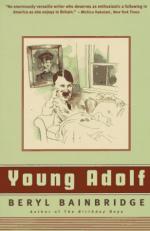
Having published ten novels in thirteen years, primarily to "tell her story," Beryl Bainbridge has good reason to view her literary career with satisfaction. An unassuming and deferential person, Bain...
Read more
An entertaining and insightful observer of the human condition, Beryl Bainbridge is one of the most highly regarded fiction writers in Great Britain. She began her career with a series of blackly humo...
Read more

Critical Essay by Julia O'faolain
Muting her technique to match her subject, [in "A Quiet Life" Beryl Bainbridge] works with the sly precision of a trap. Early on she plants a fo...
Read more
Critical Essay by Claire Tomalin
Binny [protagonist of Injury Time] …, mother of three, husbandless, in her mid-forties, is not the first Beryl Bainbridge heroine to be afflicted with an indig...
Read more
Critical Essay by James Brockway
[It's] from Harriet said …, the first to be written, back in the Fifties, and eventually published … in 1972, that the Bainbridge oeuvre as we kn...
Read more
Critical Essay by Gilberto Perez
The limited point of view of a character can be a tiresome device, especially when it is used ironically by an author who clearly knows better than the character we a...
Read more
Critical Essay by Edith Milton
Beryl Bainbridge's A Quiet Life [is a success]. The quintessential family novel, its tiny world is confined to Mother, Father, and daughter Madge. It is son Alan...
Read more
Critical Essay by John Mellors
Beryl Bainbridge writes horror-comics. She is ruthlessly funny about drab, even squalid, lives which are interrupted and changed for ever by some unexpected eventȁ...
Read more
Critical Essay by Edith Milton
Macbeth's was perhaps the most memorable, but from the time of Hrothgar's, which lasted several nights, to the time of Gatsby's, which went on till...
Read more
Critical Essay by Olivia Manning
Nothing in Beryl Bainbridge's previous novels would lead one to expect she could launch out upon a tour de force of this nature. Young Adolf is a remarkable wo...
Read more
Critical Essay by Blake Morrison
Young Adolf is less of a success than its fascinating origins might have led us to suppose….
[By] forcing Adolf to suffer various Chaplinesque indignities, ...
Read more
Critical Essay by Diane Johnson
Beryl Bainbridge's novels are published in the United States but not much known there, which is something to be regretted. Like a family of gifted eccentrics, t...
Read more
Critical Essay by Neal Ascherson
Beryl Bainbridge has written a great deal, with compassion and cunning, about the weak. Sometimes they are women, locked into some male-constructed paddock whose gras...
Read more
Critical Essay by Judith Chernaik
Beryl Bainbridge has an extraordinary ear for the speech of drifters, refugees, entrepreneurs of various kinds, Irishwomen; her characters [in Young Adolf] probably ...
Read more
Critical Essay by Gillian Wilce
'It was as if they had all been plucked up out of nowhere, and set down with the express purpose of being amusing or interesting or something, and they had all ...
Read more
Critical Essay by Emma Fisher
The early Bainbridge dwelt on each moment, was too explicit; when a character spoke, he also made a physical gesture or his hair shone in the sunlight, and his inner tho...
Read more
Critical Essay by John Naughton
[In Another Part of the Wood] Ms Bainbridge uses a conventional device—a group holiday in deepest countryside—to collect a grotesque menagerie of creepie...
Read more
Critical Essay by Patricia Craig
[Is Another Part of the Wood] a worthy addition to the list [of Bainbridge's novels]? One's feelings are mixed. It contains many of the ingredients we h...
Read more
Critical Essay by Patricia Beer
Another Part of the Wood is a scorchingly brilliant study of a situation where the characters … state and blurt out much, and experience in their inner misgivin...
Read more
Critical Essay by Julia O'faolain
["Dead"] is this novel's final word, and a familiar one to Beryl Bainbridge's readers. This time the death is prefigured by forebo...
Read more
Critical Essay by Betty Falkenberg
Beryl Bainbridge's Another Part of the Wood is a small, precise study of small, insidious deceits—mainly self-deceits. But their triviality does not b...
Read more
Critical Essay by Julian Symons
The glancing indirection of Beryl Bainbridge's writing, its waywardness and humor, owes something to Firbank and, further back, to Sterne, but she is a genuine ...
Read more
Critical Essay by Karl Miller
Beryl Bainbridge's books are commemorative. They are an attempt to save something from [the] flux. They are an attempt at preservation.
[Harriet Said, is set o...
Read more
Critical Essay by Anne DuchÊne
Reading a Beryl Bainbridge novel has always been a special kind of experience, at once very funny, abrasive and intimate—rather like having a nasty sticki...
Read more
Critical Essay by Paul Ableman
After having read [Winter Garden] attentively, and yet without achieving total understanding, I went back and combed the text for vital clues. But they still eluded me&...
Read more
Critical Essay by Peter Conrad
Beryl Bainbridge's funny and alarming [novel, Winter Garden,] sentences its hero—who is, by his own complacent admission, 'ordinary and boring...
Read more
Critical Essay by Frank Kermode
[Winter Garden] challenges the reader to catch clues to its tone, and also to what is actually supposed to be happening. It is, in fact, a bit baffling. The story is o...
Read more
Critical Essay by Valerie Brooks
["Winter Garden"] is razor sharp, most appealing and somewhat resembles a quicksilver Stravinsky-Balanchine ballet. An unusual combination of characters...
Read more
In the following excerpted review, Thubron contrasts Bainbridge's English Journey with J. B. Priestley's 1933 book of the same title.
In the autumn of 1933 the British novelist and pl...
Read more
In the following excerpt, Wennö discusses Bainbridge's critical underestimation and argues that her novels, though regarded as conventional narratives, actually embody sophisticated dist...
Read more
In the following review, Clark offers tempered evaluation of Bainbridge's Collected Stories.
Beryl Bainbridge is a prolific and highly accomplished writer, not simply in terms of the volume ...
Read more
In the following review, Cooke offers favorable assessment of Every Man for Himself.
“Though not vain, I'm aware that my outward appearance raises expectations.” Thus 22-year-o...
Read more
In the following review, Gardam offers positive assessment of Every Man for Himself.
Beryl Bainbridge's first novel in five years is a short, taut piece of historical fiction, an account of ...
Read more
In the following essay, Punter examines the presentation of psychological trauma in Bainbridge's novels and the struggles among her characters, particularly those who are female, to deal with b...
Read more
In the following excerpted review, Updike discusses the Titanic disaster and Bainbridge's fictional recreation of the tragedy in Every Man for Himself.
The R.M.S. (Royal Mail Steamer) Titani...
Read more
In the following review, Heller offers positive assessment of Every Man for Himself.
The most famous shipwreck of our century has launched its own literary genre. Walter Lord, who penned the 1955 b...
Read more
In the following review, Heeger posts a positive assessment of Every Man for Himself.
Its very name described its lordliness on the sea. So vast its passengers got lost on it, so strong it was thou...
Read more
In the following review, Saunders offers praise for Master Georgie.
Some well-established novelists, garlanded with praise and blunted by success, become tired or lazy, or allow their once zeitgeis...
Read more
In the following review, Murtaugh offers favorable evaluation of Master Georgie.
Beryl Bainbridge's Master Georgie pursues the interests and, to some extent, the methods of her two previous ...
Read more
In the following review, Prose gives positive evaluation of Master Georgie.
Beryl Bainbridge's novels are like elegant teacups that contain a strong dark, possibly sinister but remarkable br...
Read more
In the following review, Gallagher offers favorable assessment of Master Georgie.
In this short, melancholy tale, British novelist Beryl Bainbridge all but reinvents the historical genre. Gone are ...
Read more
In the following review, Pool offers tempered praise for Master Georgie, citing shortcomings in the novel's contrived events and characterizations.
In her two previous novels, The Birthday B...
Read more
In the following review of Forever England, Lehmann-Haupt finds weakness in Bainbridge's generalizations, though interest in her autobiographic reminiscences.
Considering the differences bet...
Read more
In the following review, Forscey offers favorable assessment of Watson's Apology.
Beryl Bainbridge's 11th novel is a grim pleasure, but then so is life, and it is from life (and its d...
Read more
In the following excerpted review, Ingrams offers positive assessment of Forever England.
Last year I took on the task of compiling an anthology about England, since when I have been delving around...
Read more
In the following review, Gerrard offers tempered assessment of An Awfully Big Adventure.
This is Beryl Bainbridge's first adult novel for five years, and initially it seems as if a sweet whi...
Read more
In the following review, Prose defends Bainbridge's work against demeaning critics and offers praise for An Awfully Big Adventure.
Traditionally, the back of the book jacket is the venue for...
Read more
In the following review, Schaumburger offers praise for An Awfully Big Adventure.
If you can imagine a coming-of-age novel set in post-war Liverpool that trespasses on the macabre and metaphysical ...
Read more