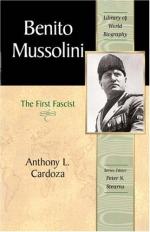
The Italian dictator Benito Mussolini (1883-1945) was head of the Italian government from 1922 to 1943. A Fascist dictator, he led Italy into three successive wars, the last of which overturned his re...
Read more
Orwell was an English novelist, essayist, and journalist. In the following review of The Trial of Mussolini, which was originally published in the London Tribune, Orwell argues against both the sense ...
Read more
In the following essay, Dasenbrock chooses the middle section of Ezra Pound's Cantos as the basis to understanding Pound's changing views on Mussolini and Italian fascism during the 1930...
Read more
In the following essay, Sicari examines Ezra Pound's Cantos written before the fall of Mussolini and Italian fascism to find evidence of Pound's conception of the prototypical fascist he...
Read more
In the following essay, Cody suggests that the attraction of Mussolini was related to the notion of “personality” advanced by the German Romantics, which sought to distinguish itself fro...
Read more
In the following essay, Dasenbrock argues that Ezra Pound's devotion to Mussolini must be understood within the context of Pound's reading and understanding of the political writings of ...
Read more
In the following essay, Saporiti details Mussolini's last days of power.
Twenty-fifth July, 1943, started in Rome like any other Sunday. Under the burning sun, the rare passers-by who crossed t...
Read more
In the following review of The Fall of Mussolini: His Own Story by Benito Mussolini, Albrecht-Carrié considers the volume a “distorted” account of the events surrounding Mussolini...
Read more
In the following review of Benito Mussolini: Memoirs 1942-1943, the anonymous critic considers the memoirs biographically and politically significant but otherwise lacking in substance.
Benito Mussoli...
Read more
In the following review of The Brutal Friendship: Mussolini, Hitler, and the Fall of Italian Fascism, the anonymous critic calls the book “enthralling reading.”
Mr. Deakin's The B...
Read more
In the following essay, Namier examines Mussolini and his regime using the diary of his foreign minister and son-in-law, Galeazzo Ciano.
In a secluded room of the Italian Foreign Office, the Palazzo C...
Read more
In the following essay, Diggins explains the varied reactions of American literary intellectuals—including Henry Miller, John Horne Burns, Sinclair Lewis, and Ernest Hemingway—to Italian...
Read more
In the following essay, Diggins explores Mussolini's appeal to Americans as a signifier of heroic redemption.
The Images of Mussolini
To conclude a study of the Mussolini vogue [in Mussolini an...
Read more
In the following review of Mussolini: An Intimate Biography by His Widow, Barzini describes conditions in Italy that led to Mussolini's rise to power and many personal and character traits that...
Read more
In history, many leaders become famous for their contributions to a particular country. However, this fame may not always be the result of a positive contribution. Leaders such as Hitler, Ivan the ...
Read more
The Methods Used By Mussolini
To Gain Power
Mussolini came into Italy at a difficult time. People everywhere were poor and desperate. The unemployment rate had skyrocketed after WWI. Many people b...
Read more
If you think Hitler created all that madness alone, you would be wrong. Benito Mussolini aided Hitler and was just as power hungry and bloodthirsty as was Hitler. Mussolini's modest beginnings and r...
Read more
Benito Mussolini, known in Italy for his dictatorship, was born on July 29th of 1883. Mussolini had spent almost 21 years ruling Italy as a dictator. He tried building Italy into an empire, but lef...
Read more
Benito Mussolini: Il Duce
Benito Mussolini, an inspirational, yet violent man whose ideas inspired even the depraved Hitler during his establishment of the Third Reich. Mussolini rose to power when ...
Read more
The Fascist Government of Benito Mussolini
Benito Mussolini is the name that is automatically thought of when Fascism is mentioned. Society will question that and ask the reason, "why?" This is b...

Read more
"Duce! Duce! Duce! [Leader! Leader! Leader!]" the crowd chants, filling the sky above Rome with their love and adoration"(Downing 5). The "Duce" whom the people of Italy were chanting for was Beni...
Read more