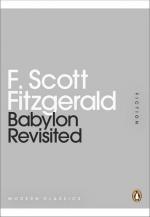
Biography EssayF. Scott Fitzgerald was a writer very much of his own time. As Malcolm Cowley once put it, he lived in a room full of clocks and calendars. The years ticked away while he noted the song...
Read more
The American author Francis Scott Key Fitzgerald (1896-1940), a legendary figure of the 1920s, was a scrupulous artist, a graceful stylist, and an exceptional craftsman. His tragic life was an ironic ...
Read more
F. Scott Fitzgerald died on the afternoon of December 21, 1940, suffering a fatal heart attack as he was finishing a chocolate bar--one of his placebos for the alcohol that had ravaged both his talent...
Read more
An air of transience pervades the biographies of F. Scott Fitzgerald and Zelda Sayre Fitzgerald and slips into their writing. This lack of permanence is a key to understanding their relationship with ...
Read more
F. Scott Fitzgerald was a writer very much of his own time. As Malcolm Cowley once put it, he lived in a room full of clocks and calendars. The years ticked away while he noted the songs, the shows, ...
Read more
Although for the general reader F. Scott Fitzgerald 's fame rests primarily on one novel, The Great Gatsby (1925), his creative life, from youth to early death, found full expression in some 160 shor...
Read more
In the following essay, Harrison asserts that although Charlie Wales has begun to mature, he is still drawn to his former life.
The usual interpretation of F. Scott Fitzgerald's "Baby...
Read more
In the following excerpt, Gallo describes the destructive power of money as an important theme in the story.
In "Babylon Revisited" (December 1930; Post February 21, 1931; Taps at Rev...
Read more
In the following essay, Twitchell refutes the argument that Charlie Wales is unreformed.
In recent years there has been a small critical hubbub over the completeness of Charlie Wales's refor...
Read more
In the following essay, Gervais contends that "Babylon Revisited" falls within the tradition of dirges for the past and compares it to François Villon's "Ballade of ...
Read more
In the following essay, Murphy and Slattery argue that a paragraph should be deleted from the "authorized" version of "Babylon Revisited" to reflect Fitzgerald's fin...
Read more
In the following essay, Nettels discusses the many similarities shared by "Babylon Revisited" and a story by Howells, concluding that although the plots are alike, the perspectives on li...
Read more
In the following essay, Baker analyzes images of freedom and imprisonment in "Babylon Revisited."
A kind of change came in my fate, My keepers grew compassionate, I know not what had ...
Read more
In the following excerpt, Phillips compares "Babylon Revisited" with a screenplay that Fitzgerald adapted from the story and with a film that was loosely based on the story. Phillips rem...
Read more
In the following essay, Turner demonstrates that frequent references to time in "Babylon Revisited" support a theme important to the story.
F. Scott Fitzgerald uses many references to...
Read more
In the following essay, Eby focuses on Fitzgerald's use of double entendre to convey the themes of the story.
"Babylon Revisited" is by any reckoning the most frequently anthol...
Read more
In the following essay, Hagopian examines what he describes as religious, Dantesque elements in the story.
Despite the obvious symbolism of the title, critics have not generally observed that F...
Read more
In the following essay, Griffith accounts for the inconsistencies in the route Charlie takes from the Ritz Bar to the home of Lincoln and Marion Peters.
Although "Babylon Revisited" i...
Read more
In the following essay, Gross refutes James M. Harrison's argument that Charlie is still drawn to his former Life.
Thus, though we cannot make our sun Stand still, yet we will make him run....
Read more
In the following essay, Osborne examines the symbolic meaning of the name "Charlie Wales."
Not only does the title of F. Scott Fitzgerald's short story "Babylon Revisite...
Read more
In the following essay, Staley demonstrates how Charlie's past and present interact to influence his future.
Kant wrote that time is the most characteristic mode of our experience, and, as H...
Read more
In the following essay, Male contends that Charlie Wales has not reformed because he is still torn between his former life and his present one.
F. Scott Fitzgerald's "Babylon Revisite...
Read more
In the following essay, Edenbaum contends that, through an inconsistency in the plot, Fitzgerald reveals that he identifies with Charlie Wales.
F. Scott Fitzgerald's story "Babylon Re...
Read more
In the following essay, Toor argues that Charlie Wales is trapped between self-justification and self-recrimination.
Roy R. Male's perceptive article on "Babylon Revisited" goe...
Read more
In life, one must realize that it is impossible to be perfect and so there are always going to be things that one will regret. Modernist author, F. Scott Fitzgerald, in his short story, "Babylon Revis...
Read more
F. S. Fitzgerald's Fighting the Past and Self-Loathing in "Babylon Revisited"
Franklin Scott Fitzgerald's life as a writer in the 1920's shaped the stories that he created. Much of the content of ma...
Read more
This paper reviews two short stories of men in decline. In both stories the main characters face similar problems and suffer from similar illusions, but the authors describe these problems in differen...
Read more