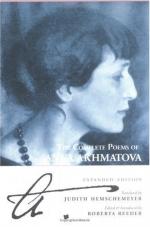
Anna Akhmatova
(1889 - 1966)
(Born Anna Andreevna Gorenko) Russian poet, essayist, and translator.
Anna Akhmatova: Introduction
Anna Akhmatova: Principal Works
Anna Akhmatova: Primary Sources
Anna Akh...
Read more
The Soviet poet Anna Akhmatova (1889-1966) is the best-known member of the Acmeist movement. Her work is characterized by subtle understatement, careful variations in rhythm, and spontaneous recording...
Read more
Anna Akhmatova is regarded as one of the greatest Russian poets. Besides poetry, which constitutes the lion's share of her literary legacy, she wrote prose--primarily memoirs, autobiographical pieces,...
Read more

Critical Essay by Leonid I. Strakhovsky
[In Vecher, Akhmatova's first book of poems, she] speaks about simple earthly happiness and about simple intimate and personal sorrow. Love, love'...
Read more
Critical Essay by Andrei Sinyavsky
For many years Anna Akhmatova's poetry appeared to her contemporaries as if it had frozen within the restricted limits laid down by her first books: Evening, ...
Read more
Critical Essay by The Times Literary Supplement
[Anna Akhmatova's Selected Poems] ranges from whispers to anguished screams, from personal happiness to the most acute personal distress. It is l...
Read more
Critical Essay by Joseph Brodsky
Akhmatova is a traditional poet, in the highest sense of the word….
Traditional verse more vividly than free verse emphasizes the banal, or the basic, in what i...
Read more
Critical Essay by Amanda Haight
In Akhmatova's poems we are faced with three images of the poet: the one arising out of the facts of her biography; the one created by Russo-Soviet criticism of ...
Read more
Critical Essay by D. M. Thomas
[Akhmatova's] incorruptibility as a person is closely linked to her most fundamental characteristic as a poet: fidelity to things as they are, to 'the clea...
Read more
Critical Essay by Nikolai Bannikov
Anna Akhmatova's personality was phenomenal. It was not given to any woman in Russian poetry before her to express herself with such convincing, lyrical power...
Read more
Critical Essay by Ronald Hingley
[The] young Akhmatova shuns the obscurity so characteristic of avant-garde verse. When she published her first poems, Russian readers had long been accustomed to expec...
Read more
In the following essay, Kunitz discusses the difficulty in translating Akhmatova's poetry from its original Russian.
Pasternak was once rebuked by a pedant who came to his door bearing a long l...
Read more
In the following essay, Brody discusses the poems in The Complete Poems of Anna Akhmatova, and Akhmatova's place in Russian literature.
Poetry not only occupies a central position in Russian so...
Read more
Russell is an author and writes for art and culture for the New York Times. In the following essay, he describes the museum in St. Petersburg dedicated to Akhmatova.
The most moving of all the museums...
Read more
In the following essay, Specter discusses the museum dedicated to Akhmatova.
St. Petersburg, Russia—In the diffuse, almost endless light of summer, it is hard to regard this city as a place of ...
Read more
In the following essay, Cavanagh discusses how Akhmatova and fellow Acmeist Osip Mandel'shtam refused to be silenced by Stalinist oppression.
In Of Grammatology (1967), Jacques Derrida apocalyp...
Read more
In the following essay, Reeder analyzes Akhmatova's poetry from the years of Stalinist oppression.
… But there is no power more formidable, more terrible in the world, than the poets...
Read more
In the following essay, Byelyakova provides an overview of Akhmatova's career.
The life of Anna Akhmatova was a tragic one. Although she had her moments of glory she also experienced terrible h...
Read more
In the following review, Reynolds discusses the world evoked by the essays in Akhmatova's My Half Century.
On the morning of May 13, 1934, Anna Akhmatova and Nadezhda Mandelstam began to clean ...
Read more
In the following review, Bayley presents an overview of Akhmatova's life and career in his discussion of three works concerning the poet: The Complete Poems of Anna Akhmatova, translated by Jud...
Read more
In the following review, Franklin judges the quality of the discussion and presentation of Akhmatova's work in In a Shattered Mirror, by Susan Amert; My Half Century, edited by Ronald Meyer; an...
Read more
In the following essay, Ketchian traces many of the devices and allusions in Akhmatova's poem "Stansy" to Pushkin.
The purpose of this paper is to analyze Axmatova's poem &...
Read more
In the following review, Lamonte discusses the ghosts that haunt the pages of Akhmatova's My Half Century.
In his preface to My Half Century, a splendid selection of the translated prose writin...
Read more
In the following review, Ketchian praises that The Complete Poems of Anna Akhmatova is an important resource for lovers of Russian poetry, but complains that further editions need better editing to co...
Read more
In the following essay, Simon analyzes what Lydia Chukovskaya's The Akhmatova Journals reveal about Anna Akhmatova, and he also points out what the book is lacking, including better footnotes a...
Read more
Critical Essay by Sam N. Driver
In [Akhmatova's] four collections after Rosary, the love theme remains dominant despite the cataclysm of war and revolution, and the total destruction of the wor...
Read more
Critical Essay by John Fuller
The 'I' of [Akhmatova's] poems is without egotism, though autobiography is her natural medium. How can we fail to be moved by the story of the victim...
Read more
Critical Essay by John Bayley
Akhmatova was a very unselfconscious poet in many ways; she had qualities of elemental force, utterance haunted and Delphic; yet these went together with elegance and sop...
Read more