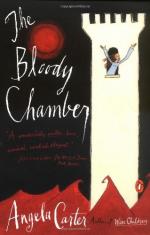
Angela Carter - (1940 - 1992)
(Full name Angela Olive Carter) English novelist, short story writer, nonfiction writer, scriptwriter, and author of children's books.
Carter is best remembered fo...
Read more
Angela Carter's fiction poses precisely the question of what is central, what eccentric in contemporary British writing. "We live in Gothic times," she wrote in an afterword to her 1974 collection of ...
Read more
During the inventive last ten years of her lifewhen she produced two of the most festive and disturbing novels of the last years of the century, Nights at the Circus (1984) and Wise Children (19...
Read more
Angela Carter's fantastic fiction is noteworthy for its stylistic excellence, its treatment of feminist themes, and its reliance on and reaction to motion-picture, fairy-tale, folklore, gothic, and sc...
Read more
In the following interview, which was conducted in New York City in 1988, Carter discusses her thoughts on myth, narrative, and modern literary theory.
Crammed in with all the other gear packed for a ...
Read more
In the following essay, Gass explores the image of the panopticon and its relation to the containment of women in Nights at the Circus.
In her “Polemical Preface” to The Sadeian Woman An...
Read more
In the following essay, Britzolakis examines Carter's fascination with the performance, or spectacle, of femininity.
Like so many girls, I passionately wanted to be an actress when I was in my ...
Read more
In the following essay, Michael examines Carter's utopian feminist vision in Nights at the Circus.
With extravagant playfulness, Angela Carter's Nights at the Circus (1984) weaves togeth...
Read more
In the following essay, Wyatt argues that Carter rewrites Freud's theories on female sexuality in The Magic Toyshop, The Passion of New Eve, and “Peter and the Wolf.”
In an essay ...
Read more
In the following essay, Berni reads Carter's short story “The Fall River Axe Murders” as a commentary on traditional literary and historical representations of the past.
Immortali...
Read more
In the following essay, Finney discusses Carter's assertion that Nights at the Circus is about the nature of narrative.
Nights at the Circus (1984), Angela Carter's penultimate novel, ep...
Read more
In the following essay, Benson explores the perception in literary criticism of Carter's use of fairy tales.
Angela Carter and the Literary Märchen: a Review Essay
It is perhaps fitting,...
Read more
In the following essay, Zipes examines Carter's early fairy tales for children for elements she would use later in her postmodern revisionist tales.
Long before Angela Carter had conceived the ...
Read more
In the following essay, Moss analyzes female desire in Carter's wolf tales.
Angela Carter's artistic evolution moves toward the realization of an alternative vision of creative desire as...
Read more
In the following essay, Langlois discusses narrative similarities in Carter's stories about Lizzie Borden.
Introduction
Angela Carter's works are new to me.1 Although I had seen the 1984...
Read more
In the following essay, Christensen examines Carter's “demythologizing” of the Lulu character in her revisions of the Lulu plays.
In her book The Sexual Circus: Wedekind's ...
Read more
In the following excerpt, Peach examines similarities between The Magic Toyshop and Heroes and Villains.
I
As I pointed out at the beginning of the previous chapter, The Magic Toyshop (1967) and Heroe...
Read more
In the following essay, Henstra analyzes the acts of reading and revision in The Sadeian Woman.
Angela Carter's critical essay on the Marquis de Sade entitled The Sadeian Woman is the most noto...
Read more
In the following essay, Goh discusses Eastern, orientalist themes in Carter's essays.
The work of deconstructing and dismantling “orientalist” discourses by such scholars as Edwar...
Read more
In the following essay, Parker interprets Carter's literature of consumption as a rebellion against patriarchy.
A great writer and a great critic, V. S. Pritchett, used to say that he swallowed...
Read more
In the following essay, Pollock discusses Carter's representation of animals in her works.
When she died in 1992, Angela Carter's close friend Salman Rushdie wrote that “English l...
Read more
In the following essay, Goertz addresses the dangers for women of being objects of desire rather than active sexual subjects in Carter's writings.
Vampires and sleeping beauties, winged trapeze...
Read more
In the following essay, Smith describes Angela Carter's novel Love as a "postmodern pastiche" of the eighteenth-century novel of sensibility.
In her afterword to the revised 1987 ...
Read more
We can read Angela Carter as both entertaining and a critique of constructions and presentations of power, gender, sexuality and construction of gendered identities. First we will consider...
Read more
The Big Bad Wolf, Prince Charming, and The Beast: many fairy tales provide images of men varying from the courageous to the very evil. Each tale encodes messages for young girls about men, marriage, o...
Read more