Baraka, Amiri (1934—)
Writer Amiri Baraka founded the 1960s Black Arts Movement, transforming white, liberal aesthetics into black nationalist poetics and politics. In 1967, he converted to Isl...
Read more
LeRoi Jones/Amiri Baraka is one author who inevitably is mentioned whenever people talk about Afro-American literature. But he is also a writer who figures prominently in the development of contempora...
Read more
LeRoi Jones / Amiri Baraka, one of the prime movers of the revolutionary black theatre and the contemporary black arts movement in general, came to the forefront of the American literary scene in the ...
Read more
An influential figure among the literary avant-garde of Greenwich Village and the lower East Side during the late 1950s and early 1950s, Amiri Baraka (known as LeRoi Jones until 1968) has been a semin...
Read more
Contemporary Afro-American literature, culture, and philosophy of the past two decades has been profoundly influenced by Amiri Baraka's social, political, and aesthetic principles. For those Americans...
Read more
The African American author Imamu Amiri Baraka (born 1934 as Everett LeRoi Jones) became influential during the 1960s as a spokesperson for radical black literature and theater.Born as Everett LeRoi J...
Read more
Biography EssayAn influential figure among the literary avant-garde of Greenwich Village and the Lower East Side during the late 1950s and early 1960s, Amiri Baraka (known as LeRoi Jones until 1968) h...
Read more



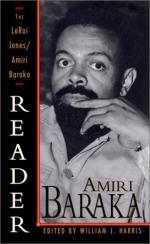
 Baraka, Amiri (1934-)
 Amiri Baraka
 Imamu Amiri Baraka
