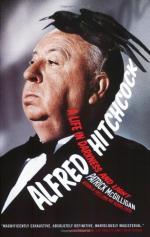
Hitchcock, Alfred (1899-1980)
Universally acknowledged as "The Master of Suspense," the British-born film director Alfred Hitchcock reached the zenith of his accomplishments within the A...
Read more
Alfred Hitchcock (1899-1980), was a film director famous for skillfully wrought suspense thrillers. He was essentially concerned with depicting the tenuous relations between people and objects and ren...
Read more
"I am out to give the public good, healthy, mental shake-ups," the late great film director Alfred Hitchcock once said back in 1936. The quote is taken from Hitchcock on Hitchcock: Selected Writings a...
Read more
In the following essay, Hemmeter reviews the textual antecedents of Alfred Hitchcock's film Sabotage, proposing that the director used both the novel and play versions of The Secret Agent by Jo...
Read more
Critical Essay by Otis Ferguson
"The Lady Vanishes" is a typical work of that genius in the art of motion pictures, Alfred Hitchcock, the overstuffed and delightful gentleman from Londo...
Read more
Critical Essay by Robert Hatch
Alfred Hitchcock might be grateful to us all if we would forget "The Lady Vanishes" and "The Thirty-Nine Steps." We pay him the compliment o...
Read more
Critical Essay by Richard Winnington
When, nearly ten years ago, Alfred Hitchcock broke away from his Daphne du Maurier phase with Shadow of a Doubt, there were premature congratulations. He was firs...
Read more
Critical Essay by Derwent May
Gracelessness is the word one wants to describe the overall quality of Alfred Hitchcock's latest film, Rear Window; and no word could be sadder. For what are the ...
Read more
Critical Essay by FranÇois Truffaut
I am convinced that [Rear Window] is one of the most important of all the seventeen Hitchcock has made in Hollywood, one of those rare films without imperfe...
Read more
Critical Essay by Andrew Sarris
[Both To Catch a Thief and The Trouble With Harry] drag along from scene to scene without much inner motivation.
Of the two films, To Catch a Thief is much more suc...
Read more
Critical Essay by Penelope Houston
[The Trouble with Harry] opens with a characteristic flourish, an incisive transition from tranquility to violence…. Unlike The Ladykillers, which broke whol...
Read more
Critical Essay by Penelope Houston
A good deal of Alfred Hitchcock's interest in film-making seems these days to consist in setting himself technical problems for the satisfaction of overcomin...
Read more
Critical Essay by James Agee
Notorious lacks many of the qualities which made the best of Alfred Hitchcock's movies so good, but it has more than enough good qualities of its own. Hitchcock ha...
Read more
Critical Essay by Ernest Callenbach
Hitchcock is said to be very pleased with [Psycho], and well he might be. In it he has abandoned the commercial geniality of his recent work and turned to out-and-...
Read more
Critical Essay by Charles Higham
At heart, [Alfred Hitchcock is] a practical joker, a cunning and sophisticated cynic amused at the French critical vogue for his work, contemptuous of the audience wh...
Read more
Critical Essay by Franz Hoellering
Precise and without pretensions, ["The Lady Vanishes"] is the best spy thriller in a long time: growing suspense from beginning to end, no empty threa...
Read more
Critical Essay by Peter Bogdanovich
The Birds could be called a hybrid of Shadow of a Doubt and Psycho. It combines the former's character-exploration with the latter's shock-effects, a...
Read more
Critical Essay by Penelope Houston
What interests Hitchcock? Not precisely character: he creates it, and his flair for casting sustains it, but it is character directed to the ends of a limited drama...
Read more
Critical Essay by John Russell Taylor
Hitchcock's career to date falls neatly into four phases: the silent period (nine films); the 1930s in Britain (fourteen films); the 1940s in America and ...
Read more
Critical Essay by FranÇois Truffaut with Helen G. Scott
To stay with the audience, Hitchcock set out to win it over by reawakening all the strong emotions of childhood. In his work the viewer ...
Read more
Critical Essay by Leo Braudy
Hitchcock cares little about the minor springs of plot—what he calls the "MacGuffin," the gimmick—because he is dealing with more inclusive rh...
Read more
Critical Essay by Joseph Mcbride
What Hitchcock has done in Topaz is exciting to anyone who believes that an artist's work has coherence, a progression, and a deepening of fundamental themes. ...
Read more
Critical Essay by Charles Thomas Samuels
Although Alfred Hitchcock is the most primitive of major directors, he belongs in their company. Those who emphasize his primitivism also dismiss his achievem...
Read more
Critical Essay by Harry Ringel
Like his painter in Blackmail … Alfred Hitchcock employs pointedly nonverbal methods—and not the expositional theatrics so common to most early sound film...
Read more
Critical Essay by Robin Wood
To trace the creative drives behind Hitchcock's films to sources in psychopathology (possible, after all, to some degree with any artist) does not necessarily inva...
Read more
Critical Essay by Andrew Sarris
Hitchcock provides only one of many possible approaches to cinema. He is not and never has been a raw realist. To enjoy Hitchcock's films, one must accept the f...
Read more
Critical Essay by Vincent Canby
Though Hitchcock's work remained out of the reach of fads, except to the extent to which he cast currently popular actors in his films, he absorbed as natural a...
Read more
Many critics believe that a Hitchcock film can be identified even if his name has been taken off the credits. I will be looking at his films such as Psycho (1960), Rear Window (1954), The 39 steps (19...
Read more

Alfred Hitchcock knew fear. Once, when he was 5 and created some mischief, his father sent him to the local police station with a note. After reading the note, a sergeant put the boy in a cell for ...
Read more
Stuart Rosenberg, a prolific director of series television and theatrical films who partnered with Paul Newman on the widely popular prison drama "Cool Hand Luke" and several other movies, has died...
Read more
Hungarian-born playwright and director George Tabori, a legend in Germany's postwar theater world whose avant-garde works confronted anti-Semitism, has died, the Berliner Ensemble said Tuesday. He ...
Read more
Japanese film director Takashi Miike's 2000 film, ''Audition,''
entered the Time magazine's top 25 picks for horror movies of all
time, according to the magazine's issue due to hit newsstands...
Read more
Question 1 of 10:
Dali
was born to a Catholic mother and atheist father in which region of
Spain
?a) Andalusia (0)b) Catalonia (1)c) Canary Islands (0)d)
Valencia
(0)Question 2 of 10:
Dali
w...
Read more
IF I DIDN'T CARERunning Time 95 minutesWritten and directed by Benjamin and Orson CummingsStarring Bill Sage, Roy Scheider
Finally, don’t pass up a nifty little film noir called If I DidnR...
Read more