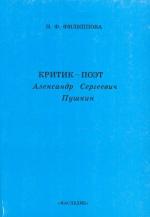
The Russian poet and prose writer Aleksandr Sergeevich Pushkin (1799-1837) ranks as the country's greatest poet. He not only brought Russian poetry to its highest excellence but also had a decisive in...
Read more
Aleksandr Pushkin continues to exert an enormous influence on Russian culture and literature more than a century and a half after his death. The impact he has made bears witness to the enormous scope ...
Read more

In the following essay, Shklovski praises Pushkin's prose and describes his historical narratives of Russian life.
I
In Pushkin's days Russian prose was chiefly imitative. In 1834 Pushki...
Read more
In the following essay, Barker argues that Hermann's actions in The Queen of Spades are the result of an unresolved Oedipal fixation.
Alexander Pushkin's story The Queen of Spades, writt...
Read more
In the following essay, originally published in 1984, Pritchett briefly surveys developments in Pushkin 's short fiction, characterizing his early prose style as "expository" and ...
Read more
In the following essay, Bayley places Pushkin's tales within a biographical context and explains the difficulty Westerners often have in detecting the originality of his works.
Pushkin is not o...
Read more
In the following excerpt, Vickery presents an overview of Pushkin's short fiction and concludes that his integral contribution to the Russian short story lies in his use of narrative technique ...
Read more
In the following review, Conquest observes that Pushkin "did not produce a literature of extreme situations, " but rather explored "the circumstances of man as a passive object. &...
Read more
In the following essay, Gide notes that the "clarity, balance, [and harmony" of Pushkin's prose works set them apart from other Russian fiction of the same period.]
French connois...
Read more
In the following essay, Shaw argues that "The Shot" offers two points of view—youth and maturity—and that Pushkin does not choose a privileged vantage for the reader.
Pu...
Read more
In the following essay, Bocharov examines Pushkin's narrative technique and use of differing modes of speech in The Queen of Spades.
"In the same way that two bodies cannot occupy the sa...
Read more
In the following essay, Emerson deploys Freudian analysis to interpret and explore the thematic significance of Grinev's dream in The Captain's Daughter.
In his historical drama Boris Go...
Read more
In the following essay, Debreczeny places Pushkin's prose within the context of European-influenced Russian fiction and suggests that even Pushkin's incomplete prose fragments were influ...
Read more
In the following essay, Mersereau analyzes Pushkin's prose fiction—particularly the Tales of Belkin—tracing influences of the tales and viewing them as part of a story cycle.
The ...
Read more
In the following essay, originally published in 1832, Gogol lauds Pushkin as Russia's national poet.
The name of Pushkin immediately evokes the thought—Russian national poet. Indeed, non...
Read more
In the following essay, Debreczeny discusses innovative developments in the narrative technique of Pushkin's prose fiction.
I
Pushkin made his first serious attempt at writing fiction in the su...
Read more
In the following essay, Karlinsky characterizes Pushkin's works as "the culmination of Russian eighteenth-century neoclassicism."
"Pushkin is our first classicist and roma...
Read more
In the following essay, Briggs presents a critical survey of Pushkin's works, concentrating on Pushkin's relation to romanticism.
I
There is every reason to associate the name of Alexand...
Read more
In the following essay, Debreczeny explores early commentary on Pushkin's works in relation to the evolution of Russian literary criticism.
The relationship between Pushkin and his critics has ...
Read more
In the following excerpt, Vickery studies Pushkin's mature lyric poetry.
The term lyric is sometimes used in Russian criticism to denote any poem belonging to the shorter genres—from the...
Read more
In the following essay, originally published in 1972, Monter probes the thematic unity of Pushkin's "Little Tragedies" in their concern with "the recognition of love and th...
Read more
In the following essay, Grossman views the centrality of the anecdote to Pushkin's prose and poetry.
Nowadays we look down upon these playthings of older children of an older time; but if ther...
Read more
In the following essay, Karpiak surveys twentieth-century thematic criticism of Pushkin's dramas The Covetous Knight, Mozart and Salieri, and The Stone Guest.
"There is nothing more diff...
Read more
In the following essay, Debreczeny considers the place of Captain Mironov's tragic execution in the otherwise comic The Captain's Daughter.
The Captain's Daughter (1836), even tho...
Read more
In the following essay, Sandier analyzes Pushkin's "André Chénier, " and observes that the poem is indicative of a significant development in Pushkin's author...
Read more